

Why Blogging Is the Secret Weapon Behind a Pinterest Strategy That Actually Works (+ How to Start)
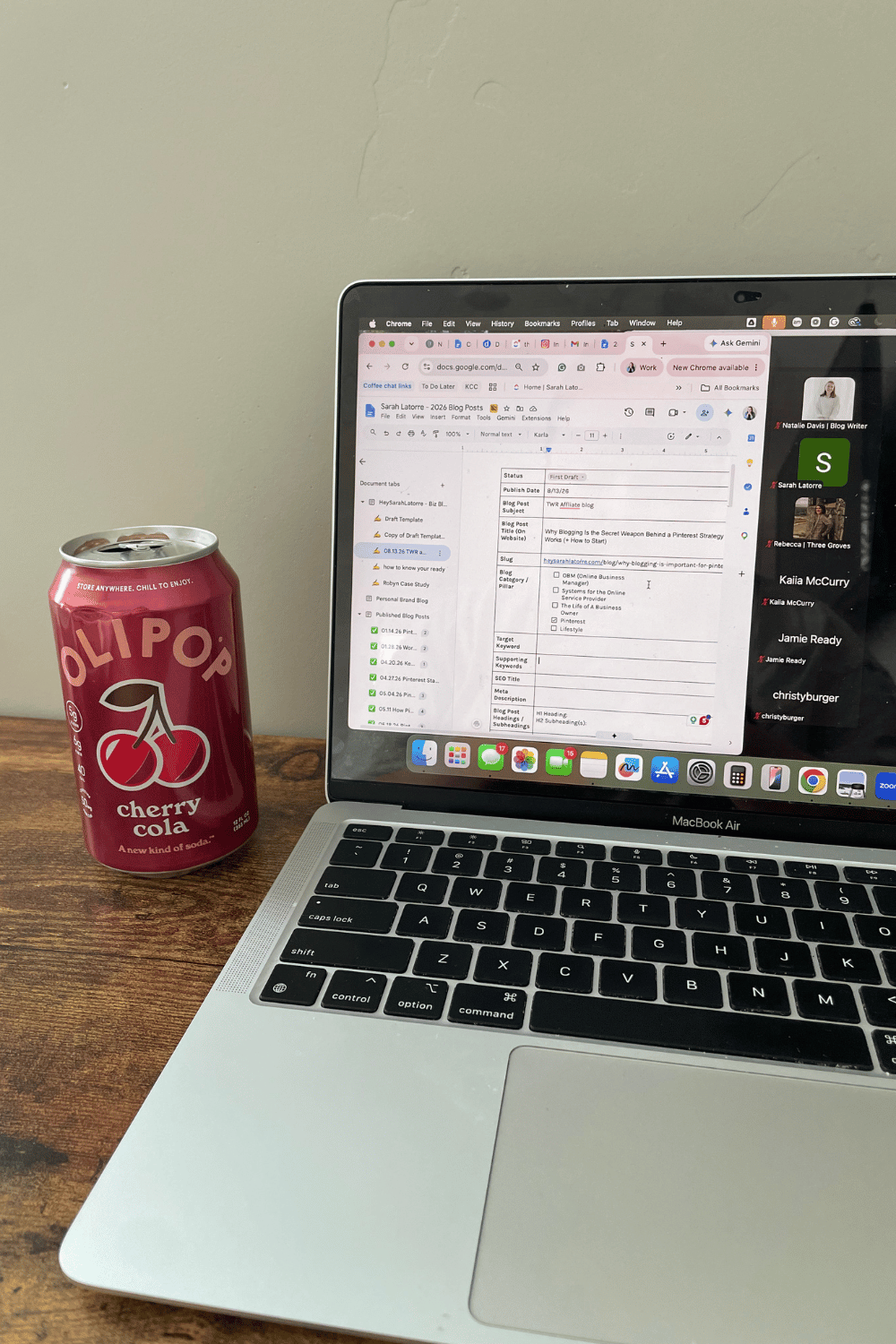
Writer’s Room Co-Writing Sesion
At the start of 2025, I had exactly 2 blog posts on my site (that were written in 2023). Then I joined a blogging membership called The Writer’s Room in July 2025 and one year later, I have 27 blogs published on my site.
I tell clients and business owners in the DMs all the time that blogging is the missing half of a real Pinterest strategy, and the past year I decided to join in on the fun too. In this post, I'm breaking down why Pinterest and blogging work so well together, how I finally became a consistent blogger, and how you can start too, even if writing has never come easily to you.
Quick note: this post contains affiliate links, which means I may earn a small commission if you join through my link (at no extra cost to you!). I'm also an active member of The Writer's Room myself, so this isn't just a recommendation; it's a membership I actually use and love. If you join, you'll see me right there in the room with you!
Why Do Pinterest and Blogging Work So Well Together?
First, you need to know that Pinterest is a search-based discovery platform that helps send users to content that answers what they're searching for, whether that's shopping links, recipe links, or a blog post that breaks down a question they're trying to figure out.
A blog post gives that Pinterest user a destination to learn more from you. Blogging has a lot of benefits on its own, like improving your website's SEO and helping your site get found in search engines and AI summaries. But it's also one of the best ways to drive traffic from Pinterest to your website.
What’s cool about Pinterest is that the users are literally coming to the platform for inspiration, to learn or plan, or to buy. And when you create blog content that supports all stages of that journey, you're really making the most of the platform.
This is why I recommend that even creators build blog content around their affiliate links. You can link directly to your affiliate links, which will help the user who's ready to purchase, but it won't do much for the user who's still in inspiration mode. That user is far more likely to click into a blog post with a roundup of your favorite products.
The same goes for business owners like service providers or product sellers. The user ready to buy will click a link to purchase your product or learn more about your service. But the user still in planning or exploration mode is far more likely to get hooked by a blog post related to what you offer.
Blogging is one of the best ways to ensure your content has longevity. It's putting in the work for you long term, helping you stay visible year after year. And the same goes for Pinterest — it's the distribution platform that puts your content in front of a lot of new eyes because people are finding it based on the terms they're actually searching for, not just hoping the algorithm feeds it to them.
Blogging plus Pinterest is the cornerstone of evergreen marketing. The work you put into both upfront keeps sending people to your website year after year, no matter what's trending that week.
Why Does Pinning to a Blog Post Outperform Pinning to a Sales or Product Page?
A lot of people wonder… “do I really need to blog in order to have an effective Pinterest account? Can’t I just link to my sales pages or product pages?”
While technically, you don’t have to blog, it’s super smart to do so and tends to work better on Pinterest. Here’s why: a sales page or product page is only going to hold the attention of a user who's actively ready to buy right now. If they aren't ready but they're still in the research or exploration phase, they'll probably head straight back to Pinterest to keep scrolling. That doesn't mean you shouldn't create pins for your product and sales pages. It just means they likely won't get the same level of visibility a blog post would.
A huge part of this that’s important to understand though is that the audience coming from Pinterest is a cold audience, which means they likely don't know who you are, and this is their first experience in your corner of the internet.
That means it takes more nurturing to turn that cold Pinterest traffic into a sale, and a blog post is a proven strategy for nurturing it. A blog post can also include multiple CTAs, link to other blog posts, and be repinned indefinitely, which a static sales page just can't do.
What Actually Got Me From 2 Blog Posts to 27 in a Year
Here’s the funny part about this though… I knew all of the above. I'd been telling clients that blogging is crucial to an effective Pinterest strategy. But knowing it and actually doing it are two very different things.
For me, blogging kept getting pushed to "someday.” I'd open a blank doc, stare at it, and go back to the parts of my business that felt easier to keep moving on.
But that changed when I joined The Writer's Room. I joined in July 2025 and one year later, I have 27 blog posts live on my site. Finally having a system and support around something I’d been avoiding made a big difference.
The most impactful support The Writer’s Room has given me is Feedback Fridays. We can submit one blog post to Natty each week, and she will edit and provide feedback. Knowing I had that opportunity motivated me to get the content written and ready to submit. And then having that feedback helped me feel confident to publish the blog post on my website.
Natty actually wrote about my experience in the membership as a case study, which you can read here.
More About Natty and The Writer's Room

If The Writer’s Room is new to you, let me introduce you to the person behind all of this. Natty is a blog writer and strategist for creative business owners and service providers who want their content to actually work for them long after they hit publish.
Before she landed on her own "blogs first, socials second" approach, she was in the same spot most of us are: constantly showing up on Instagram, feeling pressure to post, and watching that content disappear within hours. When she shifted to writing long-form blog content first and letting everything else (captions, emails, stories) flow from that, content creation became sustainable again instead of something she was just surviving.
That philosophy is exactly what she built The Writer's Room around. It's a done-with-you blog writing membership, not a course you buy and forget about, and not 1:1 coaching either. It's a true weekly support system for creative business owners who know blogging matters but can't quite make it stick on their own.
Here's what's inside:
Co-Writing Wednesdays — a live weekly session where members show up and write together, so you're never staring at a blank doc alone
Weekly feedback from Natty — you can submit one piece of content each week and get real, personalized feedback before you hit publish, not generic tips (my favorite part!)
Quarterly blog planning parties — four times a year, members map out their content strategy for the next quarter, including a repurposing plan so each post feeds social and email too
A private Slack community — where questions get answered fast, and wins get celebrated loudly
If you want more of Natty's take on blogging in general (not just inside the membership), her blog is a great resource on its own: Natty Writes Blog. It's where I often go back for anything blogging-related.
What Should You Actually Blog About as a Service Provider or Creator?
Now you might be thinking… “Sarah, this sounds great and all, but what do I even blog about?!”The good news is that you don't need a content calendar full of 40 blog post ideas to get started. You need a handful of posts that are relevant to what your audience is searching for.
Here are a few buckets I'd point you toward:
Behind-the-scenes or process posts — how you approach your work, what a client experience looks like, what goes into your service or product, day in the life posts, how you got started as a business owner or creator
Results or case studies (mainly for business owners) — show the transformation, showcase the visual elements of your work
Tools and resources roundups — the things you personally use and recommend, which is exactly where affiliate content like this lives; you can never create enough of these as a creator
FAQs your audience already asks you — if you're answering it in DMs or on calls, it's probably worth its own post
If you want specific blog post ideas, you can grab 5+ ideas for your industry from my Free Blog Ideas List.
How Do You Start Blogging If Writing Doesn't Come Naturally to You?
And because you might be thinking this too, I just want you to know that you don't have to be a "writer" to blog well. You just need a way to get out of your own head long enough to get something down.
If writing doesn’t come naturally to you, here’s what I’d encourage:
Start from something you've already said. A caption, a DM response, an FAQ you answer on repeat. You already know you have a lot to say, so just get it down on paper.
Use a template or prompt instead of a blank page. A blank doc is where most blog posts go to die. A starting structure removes the guesswork. (My free blog ideas list is a great place to start.)
Write it messy first, edit it second. Get the ideas down before you worry about how it sounds.
Build in accountability. This was what made the biggest difference for me when I joined the Writer’s Room.
Publish before it feels ready. Done and live will always outperform perfect and sitting in your drafts folder.
Ready to Actually Start Blogging?
If you've been sitting on "someday I'll start blogging" for longer than you'd like to admit, I get it. I was you a year ago with 2 posts to my name. What made the difference wasn't willpower. It was joining a space built to help me actually follow through.
You can read Natty's full breakdown of my experience here! And if you're ready to see what it could do for your own content, here's my link to join The Writer's Room.
FAQ
-
Yes, in most cases I’d recommend it. Having more links to drive traffic to that are still on your website can really help your Pinterest strategy.
-
Consistency matters more than volume. A good goal would be one well-optimized post a week to give you enough to create fresh pins consistently.
-
Yes! This post is proof. The gap most people hit isn't writing skill; it's a lack of system and accountability.
-
The Writer’s Room is a done-with-you blog writing membership for creative business owners and service providers who want blogging to be a real part of their marketing, without spending hours figuring it out on their own. It includes weekly co-writing sessions, personalized feedback from Natty, quarterly planning, and a private community.